![the[yantr].in](/assets/img/logo.png)
Blog · 01
Why magnetic particle inspection is hard to automate.
A note on what makes MPI complex and how we're approaching it. ~6 min read.
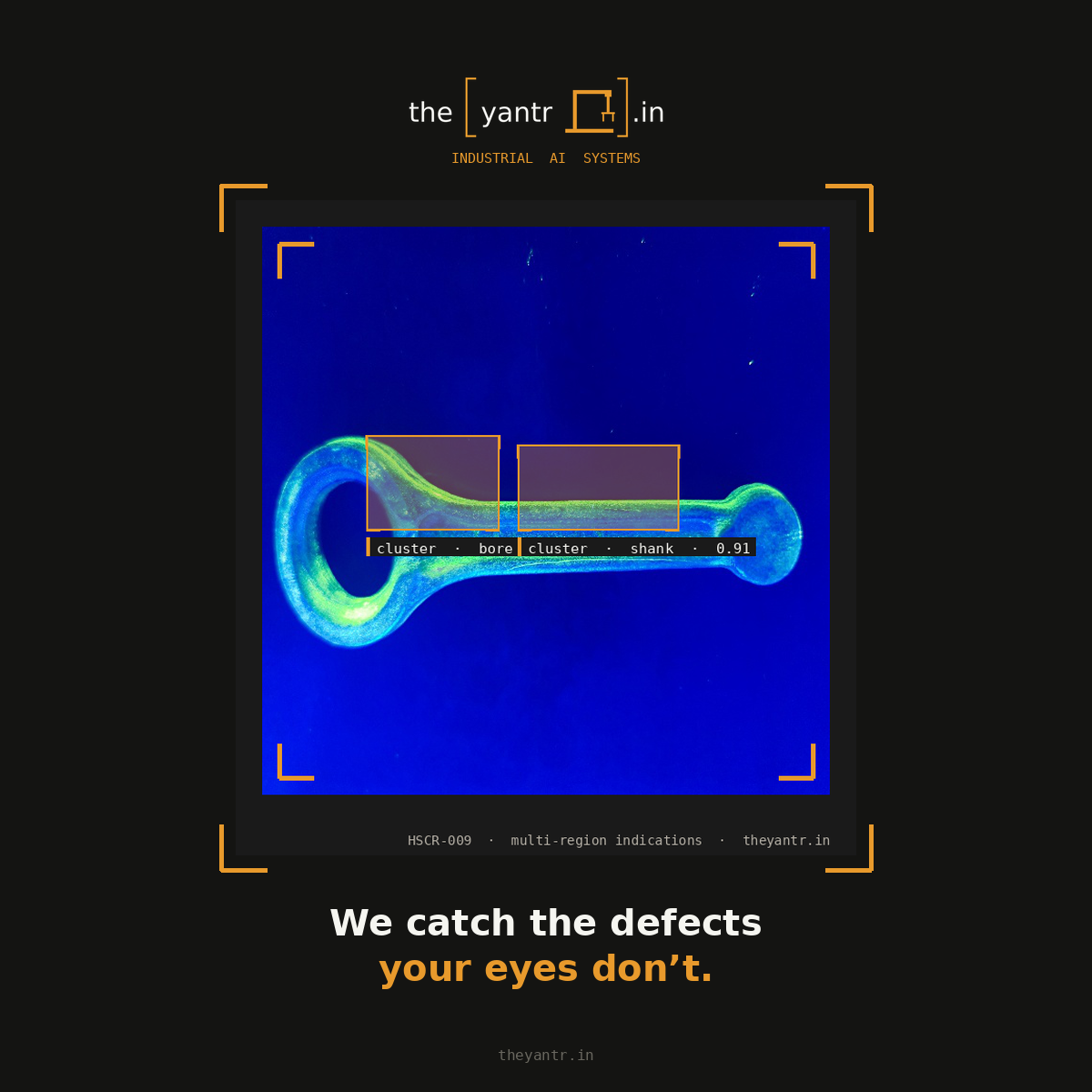
A connecting rod comes off the line, gets magnetized, and a fine mist of fluorescent iron particles is sprayed across it. In a darkened booth under UV light, an inspector looks for the bright lines that indicate a hairline crack — and decides, in about 12 seconds, whether the part ships or scraps. Six hours into a shift, that decision gets harder.
What MPI catches that nothing else does
MPI is the workhorse of safety-critical automotive inspection. Crankshafts, connecting rods, axles, suspension uprights, gears, steering knuckles — anything that sees cyclic load and is made from ferromagnetic steel ends up under a UV booth at some point in its life. The technique works because flaws in the part disturb the magnetic field, and the iron particles cluster at those disturbances. Cracks the eye can't see at room light glow under UV.
It's also one of the hardest inspections to automate. Three reasons:
Subjectivity. The certified Level II / Level III inspector is doing fine-grained pattern recognition with no ground truth. A linear indication might be a real crack, or it might be magnetic write — a benign artifact from how the magnetizing yoke contacted the surface. A blob of particles might be a porosity inclusion, or it might be machining oil residue. The same indication, on two different inspectors, can come back as accept and reject.
Inspector fatigue. ASNT studies have measured what every plant manager already knows: an inspector at hour six of a shift catches fewer indications than the same inspector at hour one. The miss rate isn't a physics problem; it's a biology problem. Manual MPI is also a profoundly boring job for a highly trained person, which is its own form of waste.
The cost of getting it wrong. A missed crack on a connecting rod doesn't show up as a defect on the line. It shows up on a customer's engine block six months later. Tier-1 supplier contracts don't survive that.
Why off-the-shelf vision systems struggle
The obvious move is to put a camera in the UV booth and let a vision system do what the inspector does. Try this and you'll find:
- The lighting is hostile. A UV booth is dark, the indications are bright, the components are reflective in some places and matte in others. Standard machine-vision cameras either blow out the highlights or lose the dim indications.
- Every component is different. A crankshaft model isn't a connecting rod model. A gear blank isn't an axle. Most vision tools that worked for one part require months of re-engineering to work on another.
- Non-relevant indications dominate. Inspectors learn to recognize the dozen ways a part can show "false positive" indications. A naive vision model flags all of them.
- The buyer is wary. This part of the inspection process is regulated. The inspector signs the test report. A vision system that "replaces" the inspector requires a mountain of validation documentation, and most plants would rather skip it.
How we do it differently
We don't replace the inspector. We give them a second pair of eyes that doesn't get tired.
Our approach has three properties that we think matter:
- Per-component fine-tuning. A crankshaft model and a connecting rod model are different models. Each one is fine-tuned during a 1–2 week pilot using actual indications from your line, classified by your certified inspector. The model learns your parts, not parts in general.
- Edge inference, in your booth. The high-resolution UV imagery doesn't go to a cloud. It runs on a small inference box in the booth, which means latency is sub-second per part and the network can fail without stopping the line.
- Suggest, don't replace. Our model surfaces indications, ranks them, and explains why. The inspector signs the report. We're a productivity tool for the certified inspector, not a substitute for one.
We've been running this in pilot at a Tier-1 forgings plant in Bengaluru for six months. Inspector workload is roughly halved, and coverage is unchanged. As we add more component models, we expect to widen that gap.
If you do MPI on your line and want to talk, book a pilot. The first conversation is free; if we're not a fit we'll say so.